

Together, alone.
Cultivating connection and community as a solo creative.


As an independent creative, business relationships can feel very, very personal. With no-one in ‘accounts’ to hide behind on chasing an overdue payment, no one to take over projects when we’re sick and no water cooler chat to ask advice about a tricky client - it can be a lonely ride.
While our creative skills and services may be what we’re employed for, its our client relationships that will make or break us as a human-sized business. And when the wheels come off, its usually because of a relational communication breakdown or misstep - and it feels very personal.
The ‘community’ around a creative business is made up of clients, colleagues, collaborators and even, your competitors. But by far, the most important relationship you have in your business is the one you have with yourself. Don’t cringe, hear me out.
If you are not bringing a high level of self-awareness to the table, you are going to hit a lot of road blocks in your relationships at work as a sole trader - especially in your communications and expectations around roles and responsibilities on a project.
Trust me, I know because I’ve spent over 20 years building and maintaining a freelancer business. I was living a ‘gig economy’ before it was even named that - and I was managing work from home logistics long before the pandemic. I’ve also lived regionally since 2013 so I’ve leaned hard on the internet since then, to make sure I can maintain relationships in between IRL interactions with clients and colleagues.
Over the years, I’ve completed a variety of professional development, leadership and coaching courses - some more ‘woo’ and some a little corporate. All along the spectrum, the key components for relationships at work tend to boil down to these:
Identifying your own triggers, such as another person being late or having a different view on a topic - and your behavioural responses to this, such as avoidance, aggression, overachieving, over-communicating, underachieving or back channeling / gossiping. Our responses tend to have their roots in our family of origin.
Learning a variety of appropriate tools that can help our awareness, action and communication around these behaviours for the benefit of the project or organisation.
While many feel we can neatly compartmentalise parts of our lives - we inevitably do bring our whole selves to work - including our subconscious triggers and we need to be aware of which behaviours can come to work and which ones can’t. We’ve all worked with someone who hasn’t got a handle on this.
It’s not as though we’re beholden to our childhood issues all day long at work, but it’s good to have some awareness - if not for ourselves, then also for our collaborators, clients and colleagues. Self awareness is not only becoming less woo in mainstream workplaces, it’s critical to working as an independent creative or freelancer.

Is this client the marrying kind? Or a one-off project dalliance?
Once we’ve got all our childhood issues resolved (ha!), the next key criteria for sustainability in business is: to nurture and cultivate repeat clients.
For me, long term client and collaborator relationships ideally involve shared values, complimentary skillsets, a sense of camaraderie and autonomy. It’s basically a marriage! In addition to this, for me personally - it also has to feel fair for everyone and be a lot of fun! It’s a lot to ask for but it absolutely is possible.
I like working with a mix of about 60% organisations and 40% individuals, because organisations are the most likely to become repeat clients as they have ongoing, rolling projects.
If we do a decent job, along with some self-awareness and repeat clients - we’ve got a sustainable business on our hands.


Word of mouth is my jam, not going viral.
There is often an ‘aha’ moment in my workshops where service based sole traders who have, in all honesty come to learn how to ‘win’ at Instagram - realise they may only need 4-12 clients to run a full time business. Not 100. Not 1000. They may not even need an Instagram account - which leaves many people feeling a sense of both relief and shock.
Sole traders literally cannot handle the work that ‘going viral’ may/may not deliver anyway.
Word of mouth is the creme de la creme of marketing as a creative practice. This form of trust based marketing delivers you clients that are already in your corner of the world (aesthetically, socially, professionally, geographically) so there is a far higher chance of being aligned with your values and actually becoming a repeat client.
On the topic of choosing and attracting clients - you can read my previous article:


Agreements don’t kill the magic, but assumptions sure do.
Just like personal relationships, good working relationships are built on trust and clarity of communication. The biggest mistake I see early career sole traders make (and mid-career too, if I’m honest) - is that they make a series of assumptions about their relationship with the client. The most obvious hiccups being:
That they will pay on time because they’re such nice people. Wrong.
They won’t expand the scope of the project while trying to keep the budget the same (in the friendliest of tones). Wrong.
That they will credit or acknowledge you properly for your work. Wrong.
None of these are a given - and it gets particularly sticky when the relationship is both personal and professional. Of course, many clients DO do these things, but if all clients did this, I would not be fielding questions about how to deal with these issues from hundreds of other creatives over the years.
It can be scary asking for these things up front and formalising them in a document. I don’t know if it’s an Australian thing or perhaps it’s just the arts in general, but many creatives are frightened of sending a T+C (Terms and Conditions) document or creating a contract before they commit their time, skills and energy to a project. They worry it will ‘spoil’ the warmth or make something that feels like a friendly gig become ‘too formal’. If this small act of professional behaviour is going to spook a potential client - you are dodging a bullet, my friend.
Agreements may feel scary to send and it takes some confidence to try, but it solidifies your position as a professional in your field - and it will hold you in good stead if your assumptions are indeed, incorrect once the project is underway.

A good reputation is better than a fancy personal brand.
Our personal brand as creatives is more than a logo and our chunky glasses - it’s our reputation. Our reputation is what others think of us and is based on both big things, like accolades, awards, publishing and other industry acknowledgements - as well as small things, like our tone in emails, the way we treated someone at a work event or a life snippet we’ve shared online.
You don’t have to be a master of your craft to meet basic standards of organisation, being on time and doing a decent job. Having a level of competence in these areas will help you build confidence - confidence to charge properly, assert your boundaries and clarify the agreement.
These big and small interactions weave together to become the fabric of our reputation. Being in the game for a few years - we’ll inevitably have difficult times, professional failures and/or fall outs with high status art douchebags - and let me tell you, in times like that, your good reputation is all you have to lean on to keep the lights on.

Journal Prompt and Community Question
This week’s Journal Prompt is an amended version of an activity we do on my Tide + Seek Retreats. I think it’s interesting to do some mapping around who is in your ‘orbit’. In this solar system metaphor, you are the Sun and your colleagues, clients and collaborators are planets, moons and stars.
Find a blank A4 sheet of paper and draw a small circle in the middle, with ‘me’ written inside it (you’re the sun).
Draw large and small planets and moons and write the names of people who support your business - people you bounce ideas with, collaborators, accountant, web designer, photographer, venue, curators, grant writers etc -you can include groups you are a part of too.
Now consider HOW those people support you and draw a line from their planet toward your Sun circle. Do they support you with technical services, finances, creatively?
Mine looks like: Paul > IT Support, Karen > tax and BAS, Órla > web design, Danielle > listening to and disrupting ideas for good etc etc.
However they support you, write it into the line. Good listeners, friends who ask open ended questions about your ideas and even your pets belong here.
Once you’ve written out all of the ways in which you are supported by your community in your good work, you might notice there are some areas that you need more support in.
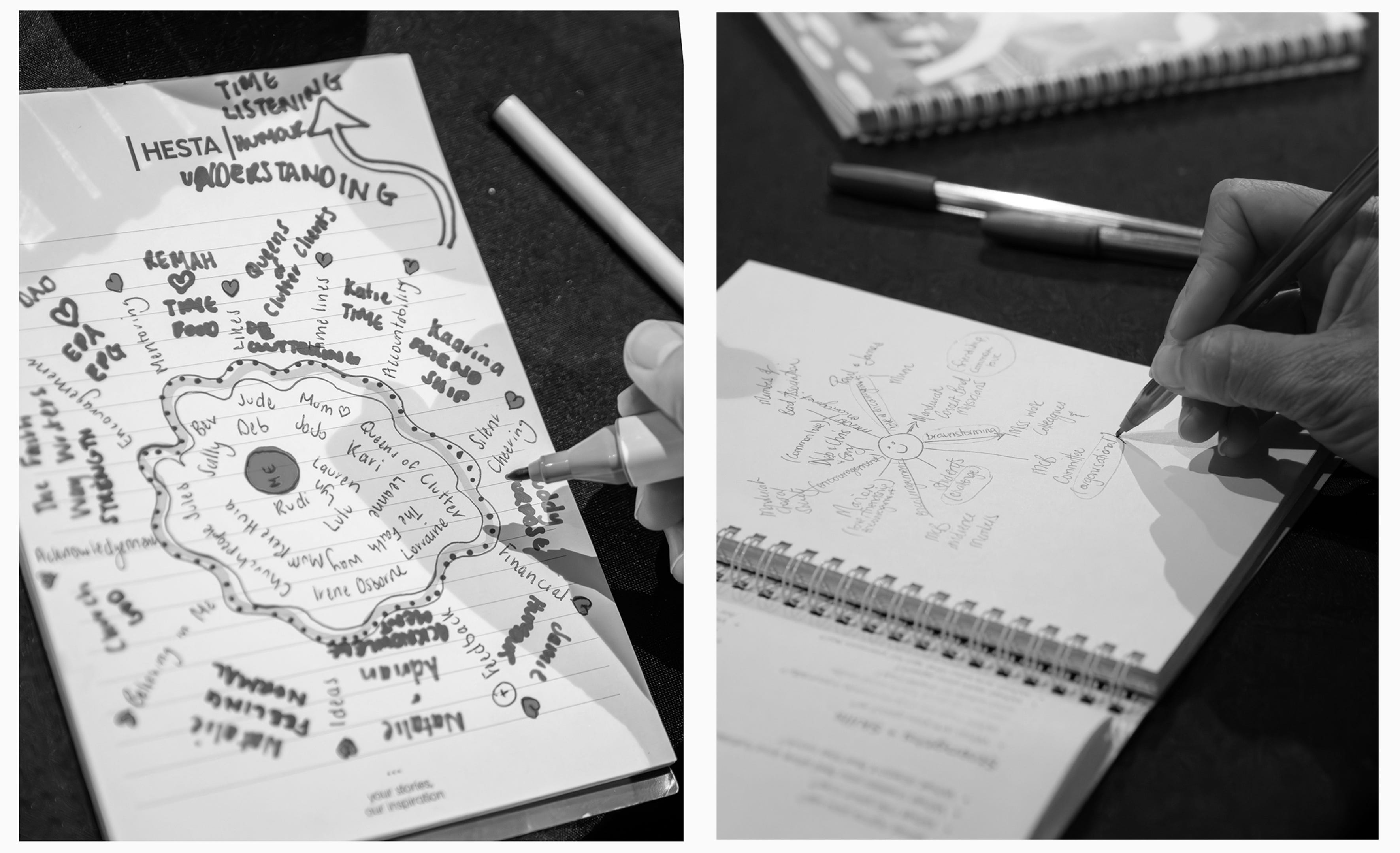
This isn’t a judgement moment - it’s a chance to see where you have some strengths and deficits right now.
This can be repeated yearly and it can be powerful to see how many people are supporting you in wonderful ways - or not. For example, I noticed in this activity many years ago that I didn’t have a mentor. There’s plenty of advice out there for emerging creatives, but not much for a mid-career creative like me. I began actively looking, knowing exactly what I needed because I could see clearly what was missing. It took me over a year to find a mentor - and it is the reason I ended up launching my own mentoring service in 2019! So this activity is one that is close to my heart. I hope you find it helpful too.
XBo
This journal article was written and recorded on Menang Noongar Boodja.
Images: from Tide + Seek Retreats, by Rae Fallon, Richard Berney, Bryce MacDonald.
So good. So many sticky moments!!
This was a great episode thanks Bo. Your writing on relationships and the importance of cultivating connections really resonated. Also - I think your field guide is for so many more people than just creatives. Working in the not for profit sector has many similarities to sole traders, especially for founders. Thank you.