

Time sensitive.
When life feels like a ticking time bomb, could I try to befriend time?

I’ve always been time sensitive.
For as long as I could remember, I’ve had a sense of being behind. Working on weekends is either ‘catching up’ or ‘getting ahead’. There’s always been scarcity attached. If I wake up and the sun is already up, I feel ‘behind’ and need to catch up.
And there are rewards associated with that. Achievements, opportunities, being seen as reliable. But there’s a dark side to it and I’ve had to face this strange, invisible fear head on.
This is what I’ve learned.

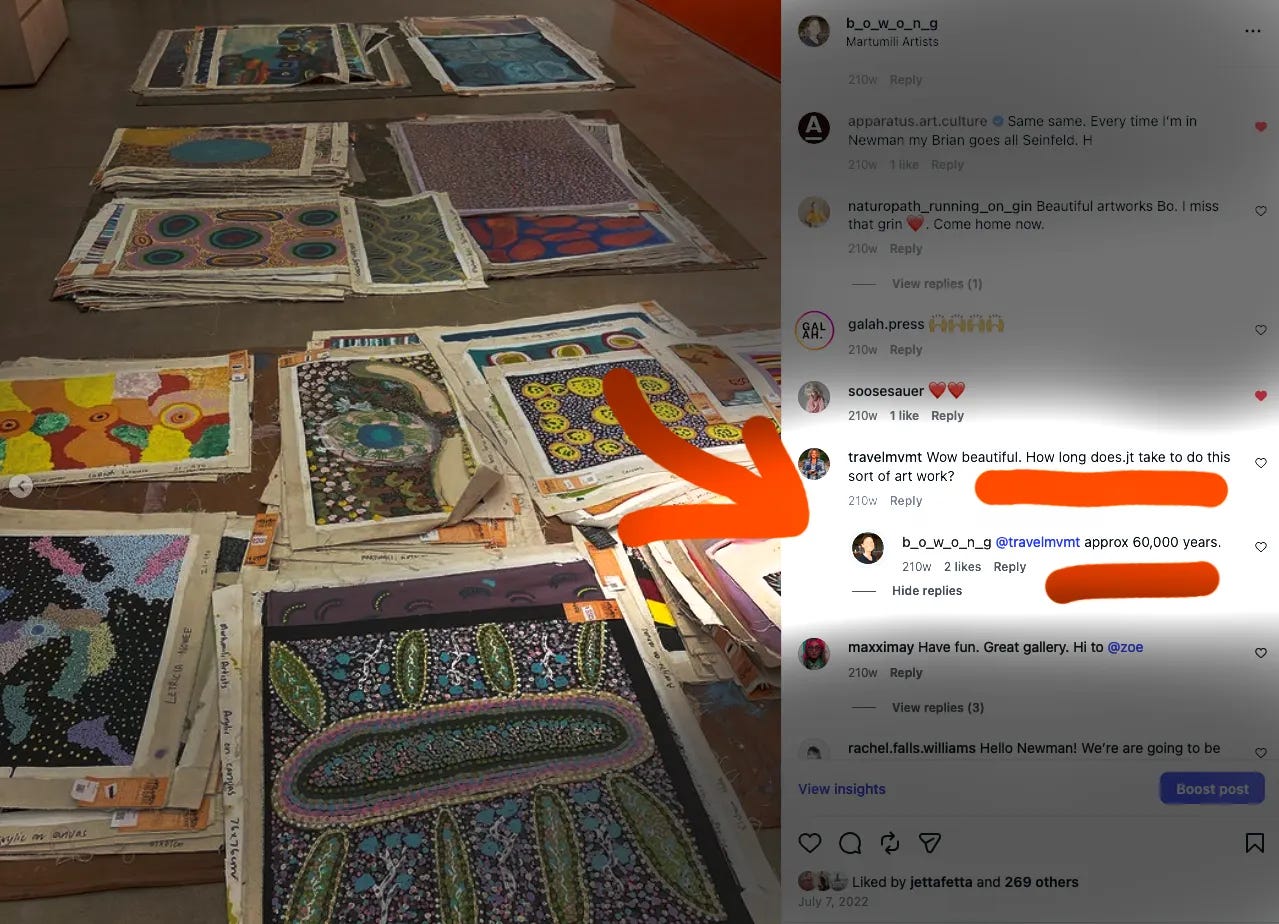
A screenshot from my Instagram account in 2022, where I made a carousel post about working at Martumili Artists.
1. Time is money. And a lot of other things.
A few years ago, I posted some photos on a work trip to an Aboriginal Art Centre in the Pilbara, including some finished canvasses by loads of different Martu artists. Someone commented ‘wow, how long does it take to do this sort of artwork?’. I replied, ‘60,000 years’. The value of an Aboriginal artwork has been evaluated by the wider (whiter?) public by the time it took to paint the physical canvas and whether or not it looks detailed - and in the past, was priced accordingly. Unlike art by non-indigenous people, which can be accepted as concept based and involve someone putting a pile of rubbish into a gallery (not being snarky, have just seen it SO MANY TIMES). White artists are rarely, if ever asked ‘how long did it take to paint/make that?’, because everyone knows that it’s irrelevant.
Even so, in creative industries we are still shackled to the ‘time = money’ equation through working in good ol’ capitalism. As creative freelancers, we trade our time for money. Our skills and talents are embedded in that time, sure - but we still need a time component in our invoices to justify value.
I know it’s not best practice to work for an hourly rate, but if you ask around, you’ll find most creative services still do this. Even the grant I am writing these words on this very second has an hourly rate attached to my writing time.
After years of working closely to the clock and having my time managed, controlled and metered out with accompanying proof on invoices, I took a Sabbatical in 2022. I needed time and space. That’s all I knew. I worked out the financials of this, did all the comms with all the clients. No small feat as a freelancer. But what really threw me? All the time I was being confronted with. I had not frittered away a single minute in 20 years.
I’d always had the sense that if I rested or took a break, I’d never get up again. Best to just keep moving. That fear was real and came true. Because if you haven’t rested for years and then suddenly have ‘down time’, the whiplash is so extraordinary that you are left seeing stars, trying to regain balance and composure. All sense of identity, structure and relationality are lost.
Because of that fear, I wasn’t asking myself the right question.
I wasn’t asking for ‘time’. What I felt I needed was to take back autonomy over my time. As a freelancer, I’ve had more autonomy over my time than most. But I was a bad boss to myself and worked myself into the ground. Then it wasn’t only autonomy over my time that I needed. I needed to offer myself some good old fashioned kindness, from time to time.
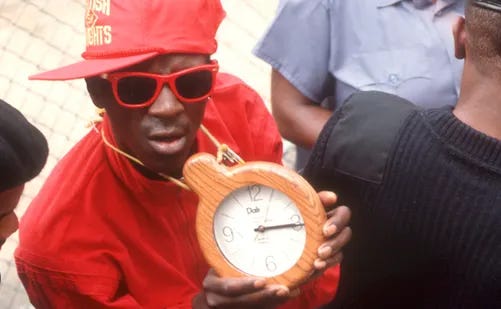
Flavor Flav also knows what was up with being time sensitive, he’s been rocking a variety of giant clock necklaces for 30 years or more!

2. My childhood was split into a 50/50 timeline.
Casting a longer lens backward, I see that my childhood had a lot of time anxiety. I lived in a shared care arrangement with constantly changing rental homes on top of training for competitive sports before and after school most days. The shared care arrangement was amicable and I loved my sports, so it wasn’t ‘bad’, I just lived out of a gym bag and had to think and forward plan ahead a lot.
When I was a toddler, my life was cut in half with my parent’s separation. I don’t remember anything before this time. With our family values of justice and fairness it became crucial that we divide our time at a rate of exactly 50/50 with each parent over the course of a year. This was a show of good faith, good divorce, good co-parenting and just generally, showing that we were ‘good’! Being in a politically progressive, divorced bi-racial family (later, my mum’s same sex partner moved in when I was 10) involved some subtext about being a poster child for how well adjusted children with all these weird things can be. Again, it wasn’t terrible and I’m not complaining, but like many kids from non white or non-hetero families, it did mean that achievements and wins would keep us safe(r) from bullying at school through making us indispensable team members.
This newly coined phenomenon of ‘co-parenting’ was even covered by a Channel 7 current affairs show with our family! Running the logistics to keep the arrangement ‘fair’ was a worthy cause and I am deeply respectful of both of my parents for it. But chasing symmetry was a source of constant time analysis, always making up for ‘lost time’.

‘Keeping a broken home a family’. My family were interviewed for this new fandangle thing called ‘co-parenting’ on Channel 7 television. As no fault divorces swept the nation and employment law meant women could legally keep their jobs after having children and therefore be independent..well it was newsworthy apparently! I’m the youngest one (Naomi).
With both of my parents dead now, this video that my step mum digitised recently is very precious to me - and though I felt hesitant to share it, it feels relevant and I know this space is a safe one to share it in, having been vulnerable here before.
My Dad always ran the kitchen clock 10 minutes fast, as there could be nothing worse than being late. On my 10th birthday I was thrilled when he gave me my wish - a digital watch! I ran it 10 minutes fast, just to be safe. As an adult, if I had a BBQ ‘from 4pm’ my Dad would arrive at 3:50pm. This was super annoying but it seemed I’d inherited the trait. Sick of being the first at BBQ’s, my partner and children staged an intervention 10 years ago in the driveway of someones house, where I had rushed everyone out the door, only to discover we were way too early. I know that ‘normal’ means arriving exactly 30 minutes after the ‘from’ time at BBQs!
Though Dad’s passed away now and I’ll never really know - I suspect his chronic time anxiety had its roots in spending his formative childhood years living in the jungles of Sarawak (Borneo) under Japanese occupation. The war ended while he was still primary school age, and he became independent when his entire family left to build a new life in Sabah without him. Why he was left as a child, I’ve never fully understood but I assume it was for educational opportunities. He threw himself into learning English and eventually won a scholarship to study in Australia, which is where he met my mum, also on a scholarship. His relationship to time and the subsequent achievements from managing it well, was likely one of survival.
Two of the most treasured memories I have from childhood were simple moments of unhurried presence: playing Battleships on a quiet afternoon at the kitchen table with my mum - and laying my head into the crook of my Dad’s armpit for a day nap, trying to get my breath to synchronise with his. Both moments probably lasted 20 minutes in time but stretch across and nourish me now, even as a 47 year old.
3. The key word in Long Covid is not Covid. It’s ‘Long’.
When people ask, ‘how’s the long covid going? I just say, ‘long’.
Long Covid is the only condition that has been named by it’s sufferers, on social media no less. If the medical establishment had had it’s way, it would have been called post-acute sequelae of Covid (PASC). But as we know, 2020 and the internet had it’s way with us - and the term was coined on Twitter by an Italian archaeologist suffering with it.
Having Long Covid is kinda like being stuck in that week after you’ve had a flu. When you think you should be getting better but you just aren’t. You get puffed taking the bins out. You decline more invitations and cancel work again. You feel ‘bone tired’. Then, other symptoms start to snowball with mitochondrial damage not converting food into energy, swollen legs, light and sound sensitivity, heart palpitations that feel like mini heart attacks, constant dizziness. In short, you feel like shit, when you ‘should be better by now’. People around you wonder quietly whether it’s ‘all in your head’.
You feel very much, behind the times.
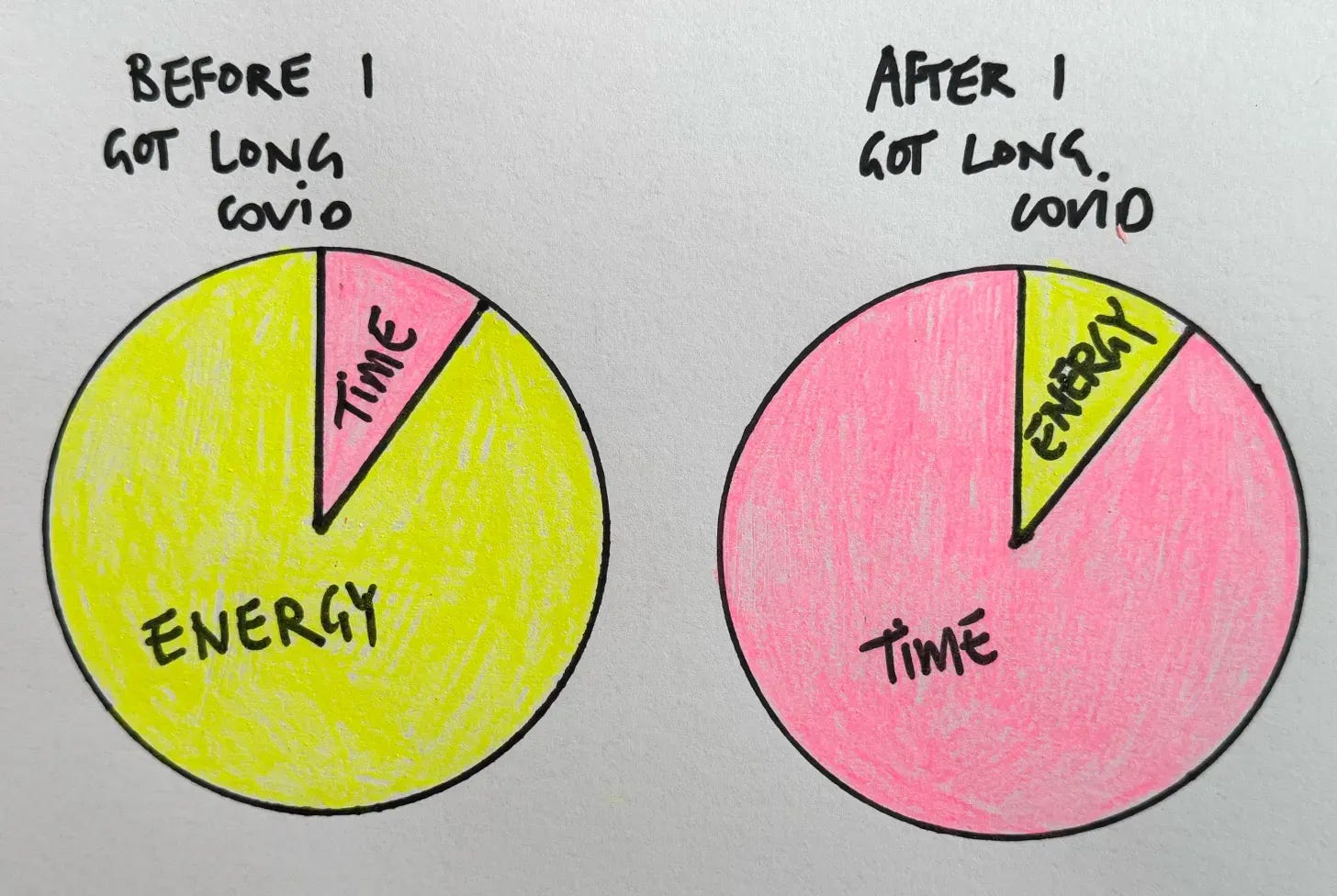
Over three years living with this condition, I’ve developed a new relationship with time. On the one hand, it’s been incredibly frustrating to watch time pass and not be able to do anything with it. On the other hand, it’s as though I was staring at a red balloon all my life - and someone popped it - and now all I see is the sky.
When I was at my worst, I had nothing BUT time. I had to pass hours and hours of every day and in a cruel twist of this condition, long nights awake - but I had no energy. Time became useless to me without vitality. The world was passing me by.
My days are guided by energy now, not time. If I have energy on waking, I’ll work. If I have more energy, I’ll exercise. If I have more energy, I’ll do housework. None of these are ever a given, so I look to an hour or two ahead at most.
My partner of 25 years is always on time - but is always rushing to fit ‘one more thing in’. I’d never noticed this before. It’s kinda annoying but I can’t fault him on it, I remember every waking hour of my life looked like that too. Until I got the speed wobbles (Covid) and the wheels came off (Long Covid) and my body crashed over and over again (did I mention, Long Covid?). There’s no ‘one more thing’ anymore. My level of prioritisation is a more triage style so after that, everything feels like a bonus.
4. In good time.
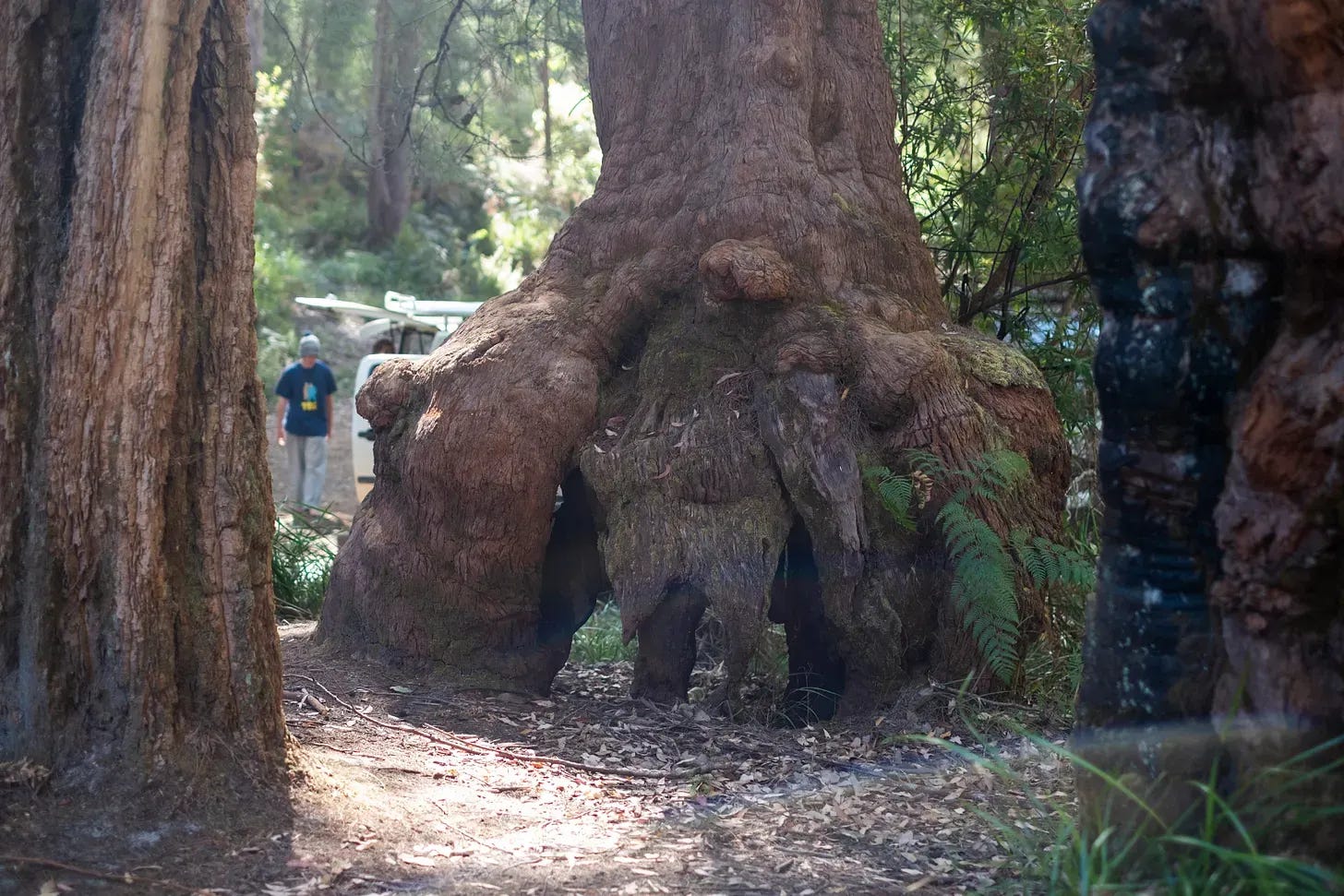
Looking at and feeling this tree at a nearby favourite family picnic spot gives me a different sense of time.
Being suddenly abundant in time, but not energy to do anything with it has been humbling.
Now, I think about things like deep time. Divine timing. Heck, I can meditate for 45 minutes without a podcast to follow these days. I don’t know if I’m really ‘meditating’. I focus on noticing my breathe moving in and out of my body. Do a few breathing exercises. Sometimes I spend time just thinking about things lately, processing. I don’t feel enlightened. But I do it anyway. I’ve met the darkest parts of myself these last few years and I’m no longer scared by stillness or darkness. I waited those motherfuckers out every day and night and I’m still standing.
Treating time like something I could extract from, is exactly the mindset that got us into this climate crisis. Stay with me. If I consider time to be as natural as the planet I live on, or the air I breathe - and stop thinking of it as a resource to ‘use’, to ‘spend’ for the sake of productivity, comfort and efficiency. What if I treated time as a life partner, a forest to live within, a source of joy in my life? Perhaps I could treat time like a cherished friend? Tend to it, listen carefully and sometimes lean on it when I’m down.
I have a little mantra that I made up, I sometimes use it for meditation or for when I feeling time scarcity. It’s a bit weird, but hey, I’m putting it all out there in this Substack. I thought I’d share it in case you want to use some of it, or put your own spin on it. It goes like this:
Perfectly timed.
Plenty of time.
A time of plenty.
I repeat this in my mind until I feel calm again. It reminds me that time is abundant and that I live in a time of abundance. That things will happen, in good time.

Journal Prompts + Community Question
Please add your thoughts into the comments in Substack, I read and respond to everyone.
How does your sense of time inform your creative practice?
Do you have a tool or technique that you could share here in the Substack comments? Something you use for managing the stress associated with time pressure that works for you (weird is fine!).
This article was written and recorded on Menang Noongar Boodja.
Ps, thank you so much for sharing the video and your experience of long covid <3
Phaww this landed! Thanks Bo. My relationship to time has drastically changed over the last year in a healthier way, but I still feel the pressure to "keep up" in the business side of my career. It sometimes creeps into the creative side too, but it never works. I need to enter into the state of no-time to let flow begin. Clarity arrives with this space, and with lettling go of the constant seeking for what to be done next. I always feel more fulfilled and accomplished with an hour of no-time existence than ticking off a hundred to-do list items.
I even doubted for a moment whether to read and listento this substack amongst all the other to-do lists, but what a gift of time it has been.
I try to practice Yoga Nidrã often to facilitate creative flow, and in a way a broader counter-culture act (or non-act) in redefining productivity.
I also regularly return to my new motto "less is more".